
Charlotte County Jail Roster Overview
The Charlotte County Sheriff's Office runs the local jail through its Bureau of Detention, and the official lookup channel is the CCSO Local Arrest Database. The sheriff hosts the roster as an embedded booking interface that covers people processed into the Charlotte County Jail. It is a current-custody and recent-booking tool, refreshed by the jail's booking system rather than a statewide index. A new booking may take time to appear, so a fresh arrest is not always visible the moment it happens.
The county roster does not show everything. It will not list a person who has been sentenced and transferred to state prison, a federal inmate whose case lives in the federal system, or an immigration detainee. Those records sit in the Florida Department of Corrections, the Federal Bureau of Prisons, and ICE systems. The roster also is not a criminal background report, so it should not be treated as a full history of a person's record.
The official roster loads inside the sheriff's wrapper page, shown on the CCSO local-arrest roster.
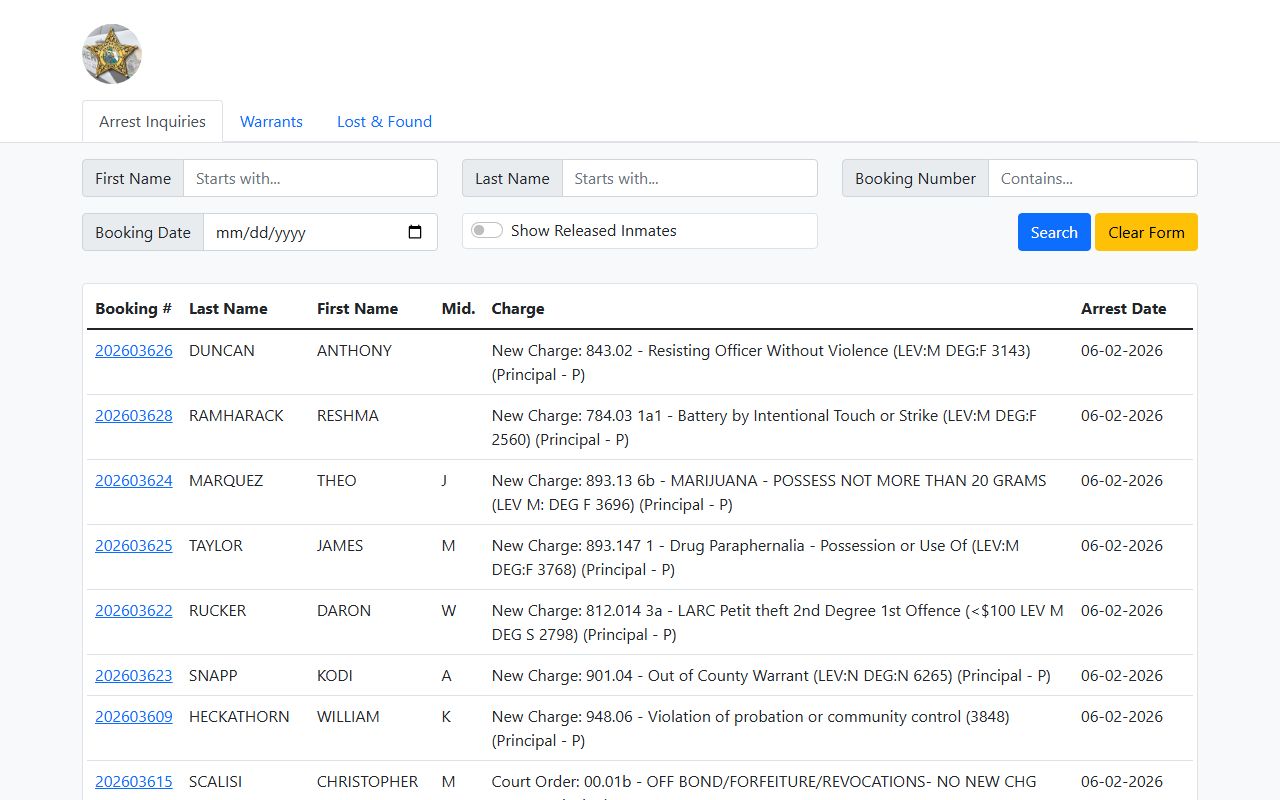
That interface is where each Charlotte County inmate search is run, and the steps below show how to work it.
How to Use the Charlotte County Inmate Roster
The roster is reached from the sheriff's correctional facility page, which links the Local Arrest Database. To start, you need a last name, and a booking number or booking date helps when the name is common. Work the search in order so you do not miss a match on a spelling difference.
- Open the CCSO Local Arrest Database from the sheriff's correctional facility menu.
- Type the inmate's last name, then add the first name to trim the list.
- Add a booking number or booking date if many people share the name.
- Open the profile to read the booking detail, charges, and custody status.
If nothing comes up, do not assume the person is free. The next sections cover the fallback channels, from the jail information line to a public-records request and the state and federal locators.
Charlotte County Roster Search Fields
The Local Arrest Database accepts a name plus a booking detail. Because the roster runs behind a vendor system, exact field labels should be confirmed in the live portal, but the reported inputs are listed below. A booking number is the cleanest way to land on a single record, while a name plus date handles most everyday searches.
| Field Label | Type | Required | Notes |
|---|---|---|---|
| Last Name | Text | Yes | Primary search input. |
| First Name | Text | No | Narrows a common last name. |
| Booking Number | Text | No | Best single-record identifier. |
| Booking Date | Date | No | Helps separate same-name matches. |
| Show Released Inmates | Toggle | No | Reported option to include recent releases. |
What a Charlotte County Inmate Profile Shows
A jail profile is built from the booking and intake record. The underlying record covers identity, booking detail, charges, the bond or release decision, classification, and housing. Public display can vary by field, and exempt material such as medical or protected information is withheld. The table below reads the core fields you can expect when you open a Charlotte County inmate record.
| Field | What It Shows |
|---|---|
| Name | The person booked into the Charlotte County Jail. |
| Booking Number | The unique identifier for that booking event. |
| Booking Date | When intake processing began. |
| Charges | The arrest charges at booking, which can differ from filed court charges. |
| Bond / Release Status | Whether bond was set and whether the person bonded out or was released. |
| Custody Status | Whether the person remains in custody or has left. |
Booking photos are part of the booking record under Florida public-records law, though live roster display can vary. The Charlotte County jail mugshots page explains how booking photos work and how to request one.
When the Roster Shows No Match
A blank result has several common causes, and each points to a different next step. The arrest may be too new for the booking to post. The person may have bonded out or been released at First Appearance Court. The name may be misspelled, or the person may be in a system the county roster does not cover.
- Call the Charlotte County Jail at (941) 833-6300 to ask about a recent booking.
- File a public-records request with the sheriff for a booking record not shown online.
- Check the Florida Department of Corrections offender search if the person was sentenced to prison.
- Check the Federal Bureau of Prisons or ICE locators for federal or immigration custody.
- Use VINELink for custody and release notifications.
Note: a person booked on a federal hold can sit in the Charlotte County Jail under the U.S. Marshals contract while the case runs through the federal courts, not the county clerk.
Finding County, State, and Federal Inmates
The right tool depends on who holds the person. The county roster covers pre-trial and short-sentence inmates in the Charlotte County Jail. Sentenced felons move to the Florida Department of Corrections locator. Federal sentenced inmates appear in the Federal Bureau of Prisons locator, and immigration detainees show in the ICE detainee locator. Matching the person to the system is what makes the search work.
| Custody | Where to Look |
|---|---|
| Pre-trial / short sentence | Charlotte County jail roster |
| Sentenced felon | Florida Department of Corrections (FDC) locator |
| Federal | Federal BOP locator |
| Immigration hold | ICE detainee locator |
Charlotte County Jail Facilities
Two facilities hold part of the local population, and they take different lookup tools. The Charlotte County Jail is the county booking center for pre-trial and short-sentence inmates. Charlotte Correctional Institution is a Florida Department of Corrections state prison for sentenced men, searched through the state locator rather than the county roster. The Charlotte County Jail page carries the full county-jail detail.
Charlotte County Jail
26601 Airport Road
Punta Gorda, FL 33982
(941) 833-6300
Video visitation by schedule; jail information line
Charlotte Correctional Institution
33123 Oil Well Road
Punta Gorda, FL 33955-9701
(941) 833-8100
State prison; FDC visitation rules apply
Booking and Classification in Charlotte County
The inmate handout describes the local path from arrest to housing. All people arrested in Charlotte County are brought to the Charlotte County Jail to be processed and to appear before a judge at First Appearance Court, except those arrested on U.S. Marshals holds, parole violations, or civil actions. Anyone who does not bond out or is not released at First Appearance Court is housed in the facility.
Where a person is housed comes from classification. The handout states that cell assignment depends on a screening that weighs current charges, prior record, age, sex, behavior, medical concerns, and other factors. Intake is also a medical checkpoint. In 2024 the jail logged 6,822 intake encounters, part of a heavy medical workload that included tens of thousands of nurse encounters across the year.
Visitation Hours and Rules
Charlotte County moved to a Smart Communications video visitation system that went live on January 2, 2024. The public registers and schedules visits online at SmartJailMail or SmartInmate, or by calling the vendor at 1-888-253-5178 or 1-727-349-1561. Missed visits caused by an outage are rescheduled and do not count against the inmate, and no recording of a video visit is allowed.
The visitation schedule is shown on the sheriff's CCSO visitation page, which posts the Smart Communications notice and the daily time blocks.
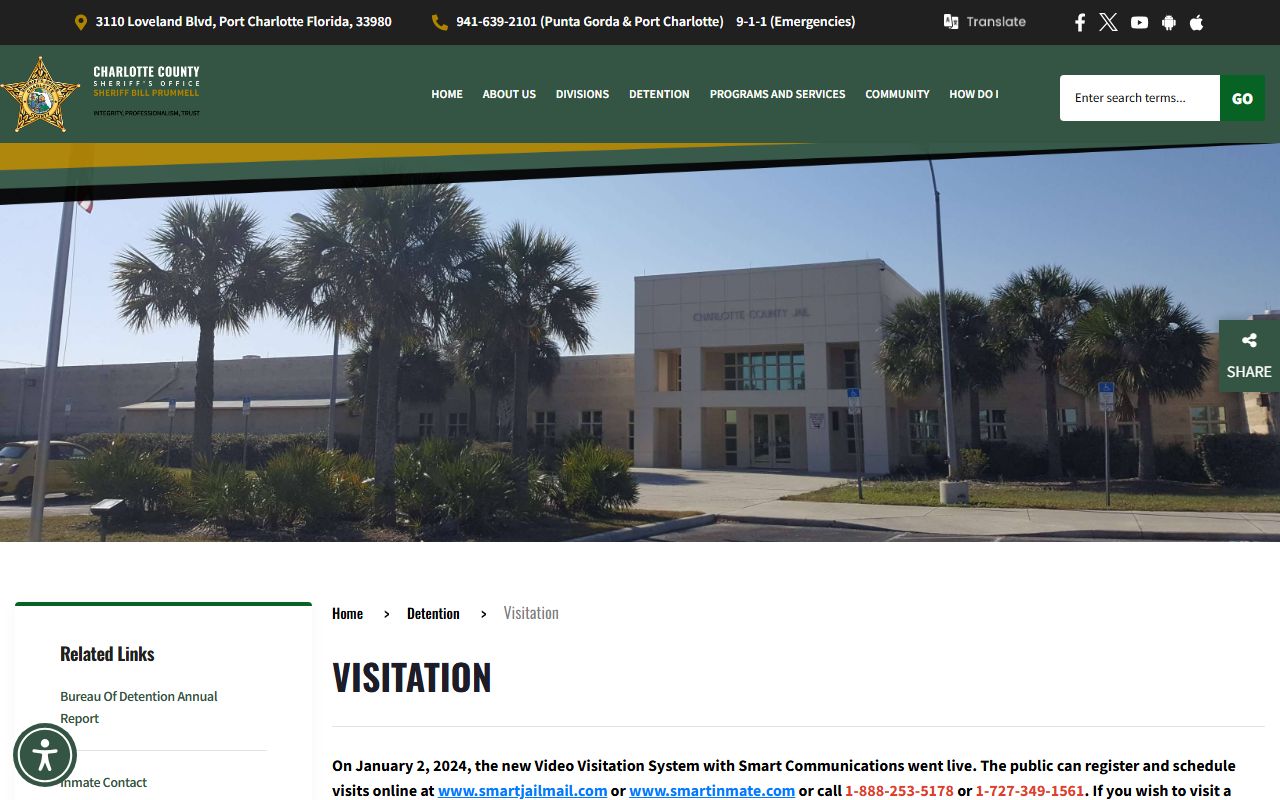
The posted onsite visitation time blocks differ between weekdays and weekends, as the table sets out.
| Day | Hours | Type |
|---|---|---|
| Monday-Friday | 12:30-1:30 PM, 2:00-3:00 PM, 3:30-4:30 PM, 5:00-6:00 PM | Video (Smart Communications) |
| Saturday | 7:00-8:00 AM, 8:30-9:30 AM, 10:00-11:00 AM, 12:30-1:30 PM, 2:00-3:00 PM, 3:30-4:30 PM, 5:00-6:00 PM | Video (Smart Communications) |
| Sunday | 7:00-8:00 AM, 8:30-9:30 AM, 10:00-11:00 AM, 12:30-1:30 PM, 2:00-3:00 PM, 3:30-4:30 PM, 5:00-6:00 PM | Video (Smart Communications) |
How to Contact a Charlotte County Inmate
Mail uses two separate addresses, and mixing them up can get a letter rejected. Personal mail goes through the Smart Communications processing center, while legal mail goes to the jail itself and is opened only in the inmate's presence. The inmate's name and ID number must be printed clearly on every piece, and a complete return address is required or the mail is treated as contraband. Two magazine subscriptions are allowed if mailed from the publisher.
- Personal mail: CCSO-SCH, Inmate Name - ID Number, PO Box 2027, Pinellas Park, FL 33780.
- Legal mail: Charlotte County Jail, Inmate Name - ID Number, 26601 Airport Rd, Punta Gorda, FL 33982.
The sheriff's inmate contact page carries the full mail rules and the SmartJail Mail registration detail.
Commissary and Inmate Funds
At admission, each inmate gets a personal money account, and cash in hand at intake is placed into it. Money can be added for bond or commissary through TouchPay by phone at 866-232-1899, online at touchpaydirect.net, or at the kiosk in the jail lobby. The sheriff defines an indigent inmate for account purposes as someone holding $1.99 or less for seven straight days or longer. All inmates except contract and witness inmates pay an initial per diem and daily subsistence fees under Florida Statutes section 951.033. The CCSO inmate funds page lays out the account and fee rules.
Note: Confirm a person is actually in Charlotte County Jail custody, and verify the booking detail, before you send money or schedule a visit.