
The Charlotte County Inmate Population
The Charlotte County inmate population is reported by the Charlotte County Sheriff's Office through its Bureau of Detention. The Bureau publishes an annual detention report, and that report is the firmest official source for the local count. For 2024, the report puts the total jail average daily population at 585. The Bureau measures the count from the disposition totals taken at 0800 each day, then averages them across the year. That figure covers everyone the jail held, not only people facing Charlotte County charges.
Several forces move the number up or down. New arrests add people each day, and the report logs an average of 16.5 bookings per day in 2024. First appearance hearings, bond rulings, and case outcomes pull people back out. When a person is sentenced to prison, that person leaves the county count and joins the state system run by the Florida Department of Corrections. The mix of all these flows is what the annual report sums up as the Charlotte County inmate population.
Charlotte County Inmate Population Statistics
The headline numbers come straight from the 2024 Bureau of Detention annual report. The jail averaged 585 people a day, and its single highest daily count of the year reached 678. The jail booked 6,016 people across the year and released 5,089. Charlotte County inmates, meaning people held on local matters, averaged 501 of the daily total. Every figure below carries its source and year so the count stays honest.
| Measure | Figure | Source / Year |
|---|---|---|
| Total jail average daily population | 585 | CCSO Bureau of Detention Annual Report, 2024 |
| Average daily Charlotte County inmates | 501 | CCSO Bureau of Detention Annual Report, 2024 |
| Average daily federal inmates | 63 | CCSO Bureau of Detention Annual Report, 2024 |
| Highest daily count of the year | 678 | CCSO Bureau of Detention Annual Report, 2024 |
| Total bookings | 6,016 | CCSO Bureau of Detention Annual Report, 2024 |
| Individual releases | 5,089 | CCSO Bureau of Detention Annual Report, 2024 |
| Average length of stay (county inmates) | 43.75 days | CCSO Bureau of Detention Annual Report, 2024 |
An official rated bed capacity was not stated in the annual report lines reviewed, so no capacity figure is shown here. The sheriff's annual report remains the source to check first when these numbers refresh.
Charlotte County Inmate Population Trends
The Charlotte County inmate population has held in a fairly tight band over five years. The Bureau's comparison table shows the total average jail population moving from 578 in 2020 down to 546 in 2021, back to 570 in 2022, up to a five-year peak of 598 in 2023, and then a slight dip to 585 in 2024. The report ties the 2020 and 2021 figures to pandemic-era disruptions that altered court activity and programming. Average length of stay tells its own story, rising to 43.75 days in 2024, the highest in the five-year span.
| Year | Average Daily Population | Notes |
|---|---|---|
| 2020 | 578 | COVID-era operations affected court activity and programming. |
| 2021 | 546 | Lowest total in the five-year comparison. |
| 2022 | 570 | Bookings and population edged back up. |
| 2023 | 598 | Five-year peak; highest daily count of 683. |
| 2024 | 585 | Slight decrease; length of stay rose to 43.75 days. |
Month to month, the count is not flat. In 2024 the monthly average ran from 555 in January to 646 in October before easing to 620 by December. That October figure was 98 people above the February low of 548.
Who Makes Up the Charlotte County Inmate Population
The 2024 report breaks the count by custody source rather than by race, age, or sex. Charlotte County inmates made up the bulk of the population at 501 a day. Federal inmates held under a U.S. Marshals contract averaged 63. Other state, courtesy, or non-Charlotte holds averaged 2, and people logged as a trip out of the facility averaged 19. The Bureau states that its inmate data collection has met Florida data-transparency requirements since 2020.
- Charlotte County inmates - 501 average daily, the local pre-trial and sentenced county share.
- Federal inmates - 63 average daily, held under the U.S. Marshals Service contract.
- Other or courtesy holds - 2 average daily, people held for other agencies or jurisdictions.
- Trip out of facility - 19 average daily, counted in the population while temporarily off site.
A public race, age, sex, or felony-versus-misdemeanor table was not published in the reviewed report. The Bureau reports operational categories instead, so those custody-source numbers are what the official record supports. The terms below help read the breakdown.
- Pre-trial detainee
- A person held while a case is pending, before any conviction.
- Sentenced county inmate
- A person serving a county jail sentence after a guilty finding or plea.
- Contract (federal) inmate
- A federal detainee housed locally under the U.S. Marshals agreement.
- Trip out of facility
- A person still counted in the population while away at court, a hospital, or transport.
- Classification
- The jail's screening that decides housing based on charges, record, and safety factors.
Federal Inmates in the Charlotte County Inmate Population
A federal share is one of the most distinct features of the Charlotte County inmate population. The 2024 annual report states that the Bureau of Detention continued its contract with the U.S. Marshals Service to house federal inmates. That contract brought 195 federal inmate bookings during the year and an average daily federal count of 63. The report notes that the contract adds revenue and lowers the local tax cost of running the jail.
The practical point for a search is simple. A person can be sitting inside the Charlotte County Jail while the criminal case is federal, not a Charlotte County matter. In those cases the county roster may show the local booking, but the case itself moves through the federal system. Readers tracking a federal defendant should not assume the county clerk has the case file.
Charlotte County Jail Capacity and Inspections
Charlotte County Jail is described in the inmate handout as a newer, state-of-the-art, tobacco-free facility. The reviewed annual report did not state an official rated bed capacity, so no capacity figure is claimed here. What the report does document is oversight. The jail passed a scheduled Florida Model Jail Standards inspection on May 16, 2024 and an unannounced inspection on November 5, 2024, meeting standards both times.
The facility also carries accreditation review. Its most recent Prison Rape Elimination Act audit was conducted in July 2023, with the next audit scheduled for 2026. A Florida Corrections Accreditation Commission onsite assessment ran December 3 to 5, 2024, and reaccreditation was recommended. No active overcrowding order, consent decree, or jail-expansion lawsuit was found in the official sources reviewed.
Laws Governing the Charlotte County Inmate Population
Florida law is what keeps jail and population data open and sets the rules the jail runs under. The Public Records Act treats booking and jail records as open unless a specific exemption applies. A separate statute drives the data collection behind the annual report. Two more statutes set the jail-standards framework that the Model Jail Standards inspections enforce. Each one below carries a short plain-English note.
Key Statutes:
Florida Statutes Chapter 119 - the Public Records Act makes state, county, and city records, including jail booking data, open for inspection unless exempt.
Florida Statutes § 900.05 - requires criminal justice data collection and reporting, the basis the sheriff cites for jail data published since 2020.
Florida Statutes § 951.23 - requires county detention facilities to adopt at least the Florida Model Jail Standards.
Florida Statutes § 951.2302 - sets the criteria for serious and notable jail-standards violations.
Note: Florida's open-records rule lets you inspect non-exempt jail records, but confidential or exempt details are redacted before public viewing.
Charlotte County and the State Prison Population
Sentenced felons do not stay in the county count. After sentencing, a person can move from the Charlotte County Jail into the Florida Department of Corrections, the statewide prison agency. FDC reports that it incarcerates more than 80,000 inmates and supervises more than 146,000 people in the community. The 2024 report counted 185 inmates sentenced to FDC from Charlotte County and logged 243 Department of Corrections transports that year.
Charlotte County also hosts one state prison inside its borders, Charlotte Correctional Institution in Punta Gorda. It is a Florida Department of Corrections facility for sentenced men, not a county jail, so it is searched through the state offender locator rather than the county roster. Anyone tracking a sentenced prisoner should look there, as the facility page for Charlotte Correctional Institution explains.
How to Search the Charlotte County Inmate Population
The official way to search current local custody is the Charlotte County Sheriff's Office Local Arrest Database. The sheriff hosts it as an embedded roster, and it covers people booked into the Charlotte County Jail. The roster is a local booking and custody tool, not a statewide criminal history search. Before you start, have the person's last name ready, and a booking number or booking date if you have one.
A clean search takes only a few steps, but the result needs careful reading. A blank result does not always mean a person is free, since the booking may be too new, the person may have been released, or the case may sit in a state or federal system instead.
- Open the CCSO Local Arrest Database from the sheriff's correctional facility page.
- Enter the inmate's last name, then add the first name to narrow the list.
- Add a booking number or booking date if the name returns many matches.
- Open the matching profile to read the booking detail and custody status.
- If the person was sentenced to prison, switch to the state offender locator instead of the county roster.
Current Inmate Lookup in Charlotte County
The current-custody roster is the first stop for a live Charlotte County inmate search. The sheriff publishes it through the CCSO Local Arrest Database, which embeds the official local-arrest roster. The wrapper page confirms the official roster, and the search controls accept a name plus a booking detail. The field list below reflects the database's reported search inputs; confirm exact labels in the live portal, since the roster runs behind a vendor system.
The Local Arrest Database wrapper shows how the sheriff frames the official roster for the public, as seen on the CCSO Local Arrest Database page.
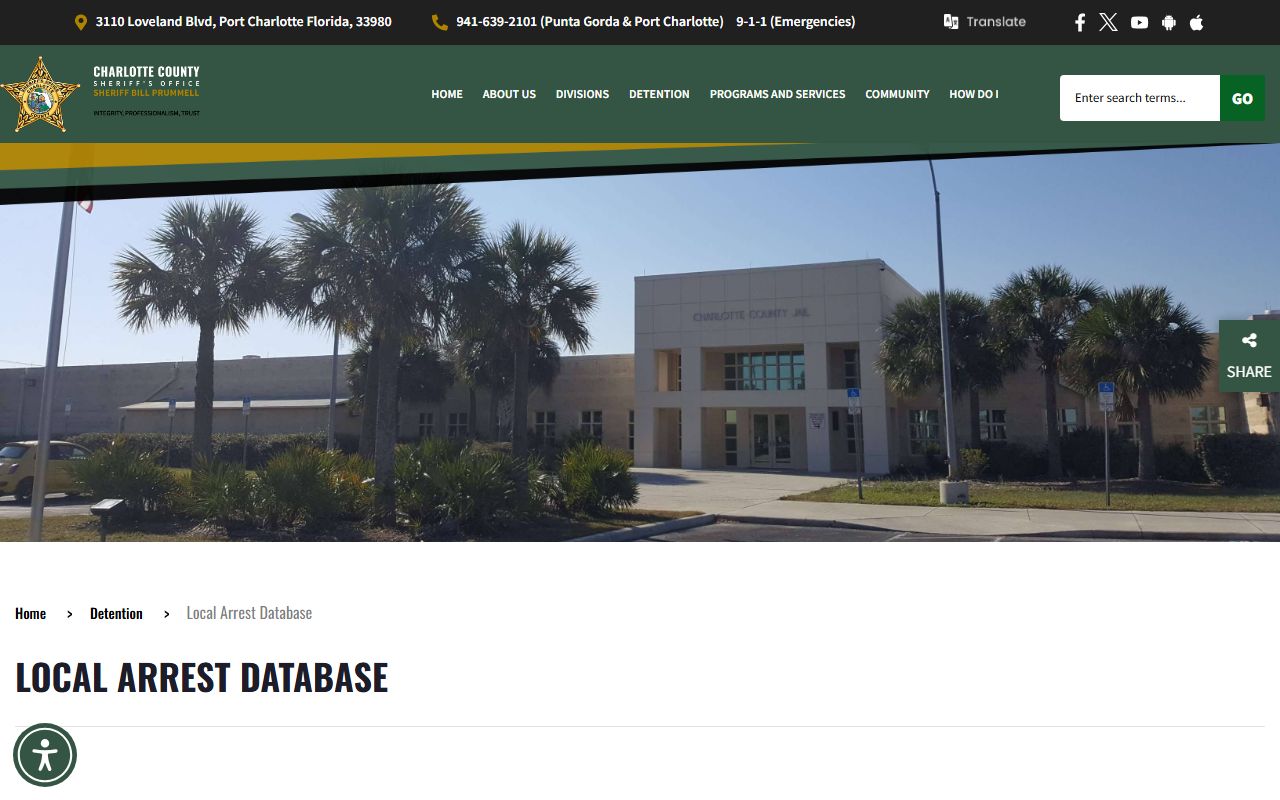
That wrapper is what loads the embedded roster, so the search you run for a current Charlotte County inmate happens inside it. Use the fields below as your starting inputs.
| Field Label | Type | Required | Notes |
|---|---|---|---|
| Last Name | Text | Yes | Primary search input; confirm exact label in the live roster. |
| First Name | Text | No | Narrows a common last name. |
| Booking Number | Text | No | Best identifier when known. |
| Booking Date | Date | No | Helps when a name returns many matches. |
| Show Released Inmates | Toggle | No | Reported option to include recently released people. |
What a Charlotte County Inmate Record Shows
A jail record is built from the booking and intake process. The underlying record covers identity, booking detail, charges, the bond or release decision, classification, and housing. Not every field is published on the public roster, and exempt details such as medical or protected information are withheld. The table reads the core fields you can expect to encounter when looking up a Charlotte County inmate, with the caution that live public display should be confirmed in the roster.
| Field | What It Shows |
|---|---|
| Name | The person booked into the Charlotte County Jail. |
| Booking Number | The unique identifier for that booking event. |
| Booking Date | When intake processing began at the jail. |
| Charges | The arrest charges at booking, which can differ from filed court charges. |
| Bond / Release Status | Whether bond was set and whether the person bonded out or was released. |
| Custody Status | Whether the person is still in custody or has been released. |
Booking photos are part of the booking record under Florida law, though live roster display can vary. The Charlotte County jail mugshots page covers how booking photos work and how to request one.
Past and Released Inmate Records
Finding someone who is no longer in custody works differently. The Local Arrest Database is built around current bookings, and a reported released-inmate option may surface recent releases. For older records, the better route is a public-records request to the sheriff. The CCSO records page accepts requests through the JustFOIA portal or in writing to the Custodian of Public Records at 7474 Utilities Road, Punta Gorda, FL 33982.
A request should name the person, give an approximate booking date, and add the booking number if known. The sheriff redacts confidential or exempt material, so ask for the non-exempt booking sheet, arrest report, and release status. If the person was sentenced and transferred, the state offender locator carries that record instead of the county roster.
County Jail vs. State Prison: Where to Look
Readers mix up the two systems constantly, and the wrong system returns the wrong answer. The county jail holds pre-trial detainees and people serving short county sentences. The state prison system holds sentenced felons after transfer. Each has its own search tool. The table sorts which slice of the Charlotte County inmate population lives in which system.
| County Jail | State Prison (DOC) | |
|---|---|---|
| Who Is Held | Pre-trial plus short county sentences | Sentenced felons |
| Run By | Charlotte County Sheriff's Office | Florida Department of Corrections (FDC) |
| Where to Look | CCSO Local Arrest Database | FDC Offender Search |
| Stays Listed | While in local custody | Through the state custody and supervision record |
State and Federal Inmate Search
Beyond the county roster, three locators cover the rest of the Charlotte County inmate population once people leave local custody. The state tool is the FDC Offender Search, which holds sentenced state prisoners and supervision records. Federal sentenced inmates appear in the Federal Bureau of Prisons locator, and immigration detainees show in the ICE Online Detainee Locator. The sheriff also links VINELink for custody and release notifications.
The state offender search is the entry point for anyone sentenced to Florida prison, including people held at Charlotte Correctional Institution, as shown on the FDC Offender Search page.
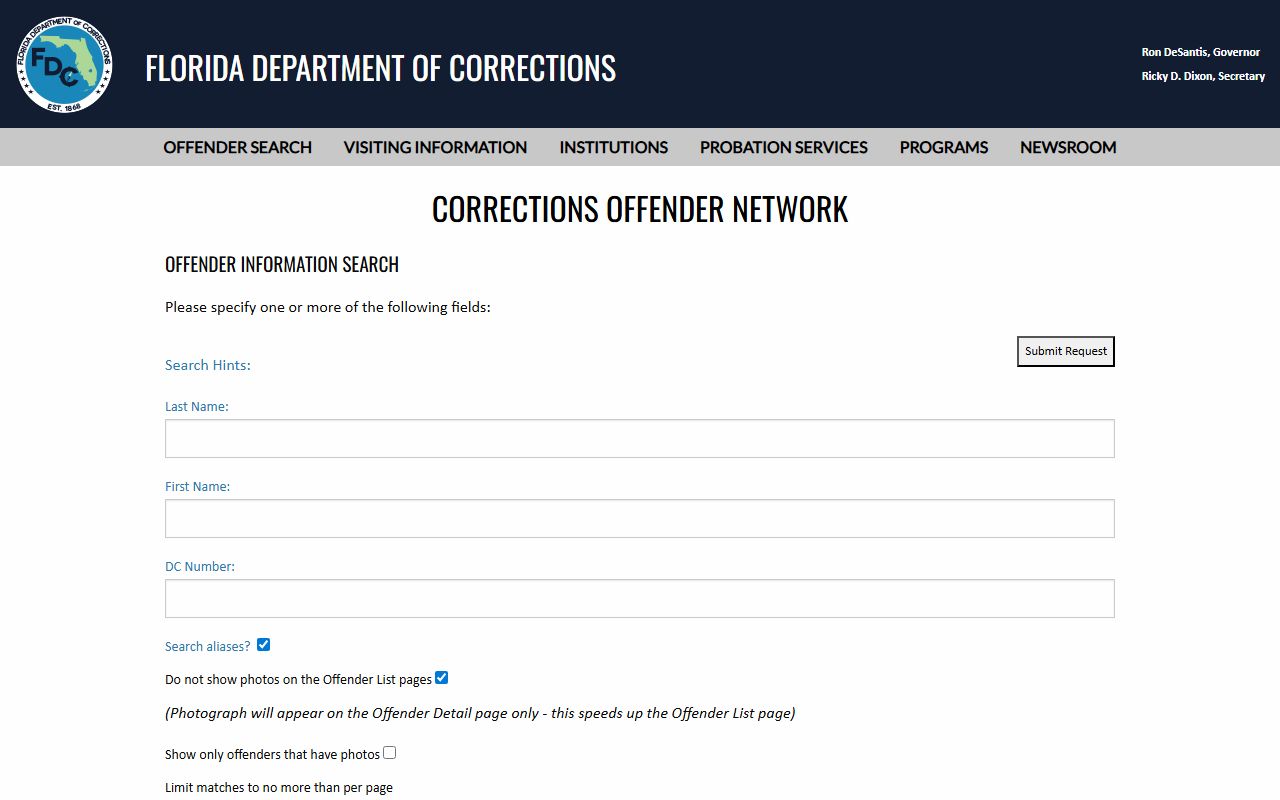
Use that state locator for sentenced prisoners and the federal or ICE locators for federal and immigration custody, since the county roster will not carry those records.
Charlotte County Detention Facilities
Two facilities hold part of the Charlotte County inmate population, and they serve different roles. The county jail is the local booking and detention center, while the state prison holds sentenced men in the Florida Department of Corrections system. Each has its own facility page with contact detail and the correct lookup tool.
- Charlotte County Jail - the primary county jail and local booking center for pre-trial, sentenced county, and contract federal inmates.
- Charlotte Correctional Institution - a Florida Department of Corrections state prison for sentenced adult men.
Charlotte County Inmate Population FAQ
How big is the Charlotte County inmate population?
For 2024, the Charlotte County Sheriff's Office Bureau of Detention reported a total jail average daily population of 585, with a single highest daily count of 678. Of that daily average, 501 were Charlotte County inmates and 63 were federal inmates held under a U.S. Marshals contract. The numbers come from the Bureau's 2024 annual detention report.
How do I search the Charlotte County inmate population?
Use the Charlotte County Sheriff's Office Local Arrest Database for current local custody. Search by last name, then add a first name, booking number, or booking date to narrow the result. The roster covers Charlotte County Jail bookings. For a sentenced state prisoner, use the Florida Department of Corrections offender search instead.
Can I look up a released or past inmate?
Sometimes. A reported released-inmate option on the roster may show recent releases, but older records are best obtained through a public-records request to the sheriff. Send the request through the CCSO JustFOIA portal or in writing to the Custodian of Public Records, and include the person's name and an approximate booking date.
Why is someone in the Charlotte County Jail on a federal case?
The Bureau of Detention houses federal inmates under a contract with the U.S. Marshals Service. In 2024, federal inmates averaged 63 a day and accounted for 195 bookings. A person can be physically held in the Charlotte County Jail while the criminal case runs through the federal courts rather than the county clerk.
Where do I look for a sentenced state prisoner?
Use the Florida Department of Corrections offender search, not the county roster. After sentencing, a person can transfer from the county jail into state prison, and FDC tracks that custody. Charlotte Correctional Institution, the state prison in the county, is also searched through the FDC locator.