
Charlotte County Court Records After a Jail Arrest
Once someone is arrested and booked in Charlotte County, the arrest paperwork and the court record are not the same thing. The jail booking reflects custody. The court record reflects the charges the prosecutor files and the case that follows. The Office of the State Attorney for the 20th Judicial Circuit reviews law-enforcement reports and evidence, then decides what to file. Those filed charges open a case, and that case becomes the court record you can search.
It helps to keep the two sides apart. For the booking and custody side, the jail inmate records page covers the roster, and the jail mugshots page covers booking photos. The court record itself, meaning the charges, court dates, and disposition, runs through the Charlotte County Clerk of the Circuit Court. Arrest charges can be amended, reduced, dropped, or filed differently once a case reaches court, so the court record after an arrest can read differently from the booking.
How to Find Charlotte County Court Records After an Arrest
Charlotte County criminal court records are handled by the Clerk of the Circuit Court and County Comptroller. The Clerk's Criminal Division covers criminal traffic, misdemeanor, county and municipal ordinance, and felony cases. The Clerk says you can locate a court date through the Case Record Search by entering a last name and first name. The official court search is the Clerk's Case Record Search portal, and the criminal division can be reached at (941) 833-3048.
The Clerk's criminal page explains the division and links the case search, as shown on the Charlotte Clerk criminal court page.
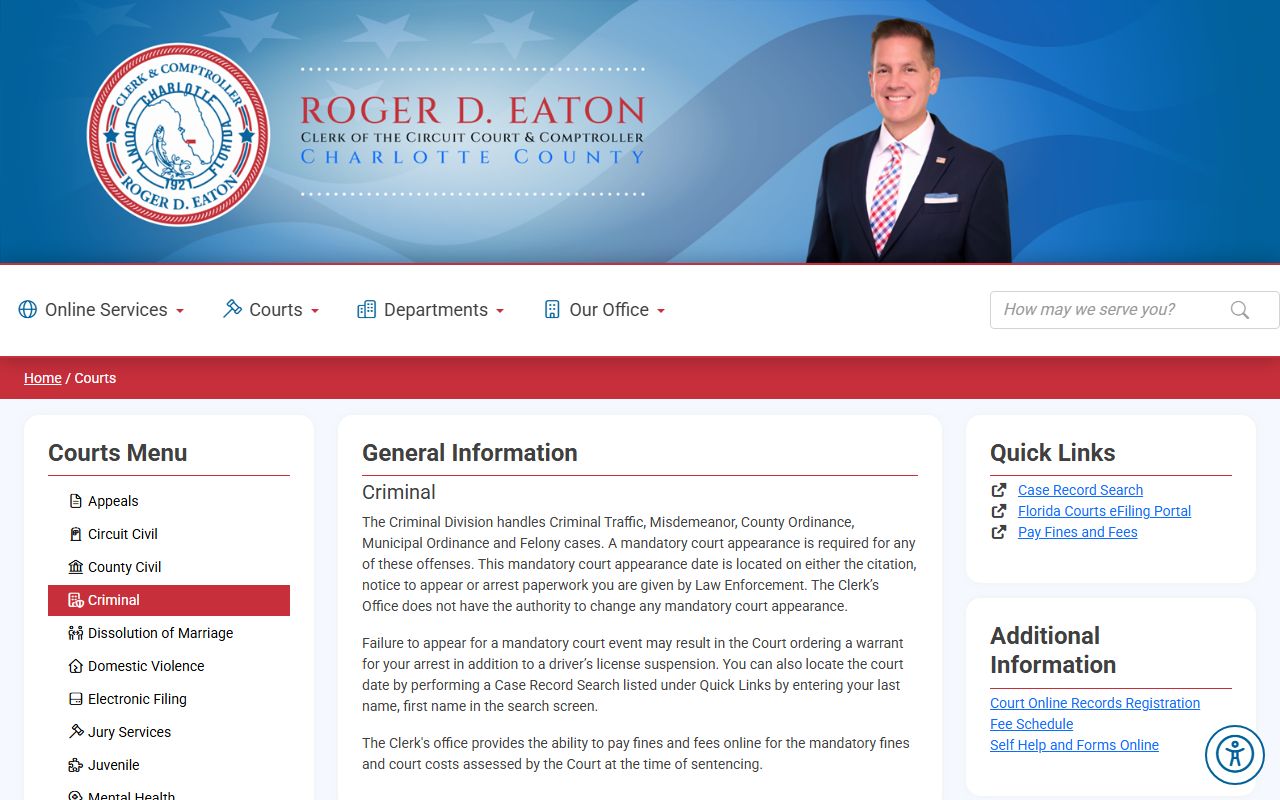
From there, the Case Record Search handles the lookup. Confirm the exact field labels in the live portal, since the UI runs on the Clerk's system.
- Open the Clerk's Case Record Search from the criminal division page.
- Search by the defendant's last name and first name, or by case number.
- Open the case to read the charge list and the court dates.
- Check each charge's code, level, and current status on the docket.
| Field Label | Type | Required | Notes |
|---|---|---|---|
| Last Name | Text | Yes | The Clerk states you search by last name, first name. |
| First Name | Text | Yes | Pairs with last name to find a court date. |
| Case Number | Text | No | Direct path when you know the case number. |
| Court / Case Type | Filter | No | Confirm available filters in the live portal. |
For criminal history beyond a single county case, use Florida Department of Law Enforcement criminal-history channels. The jail roster is not a statewide background report.
How Charges Get Filed After an Arrest: Complaint, Information, and Indictment
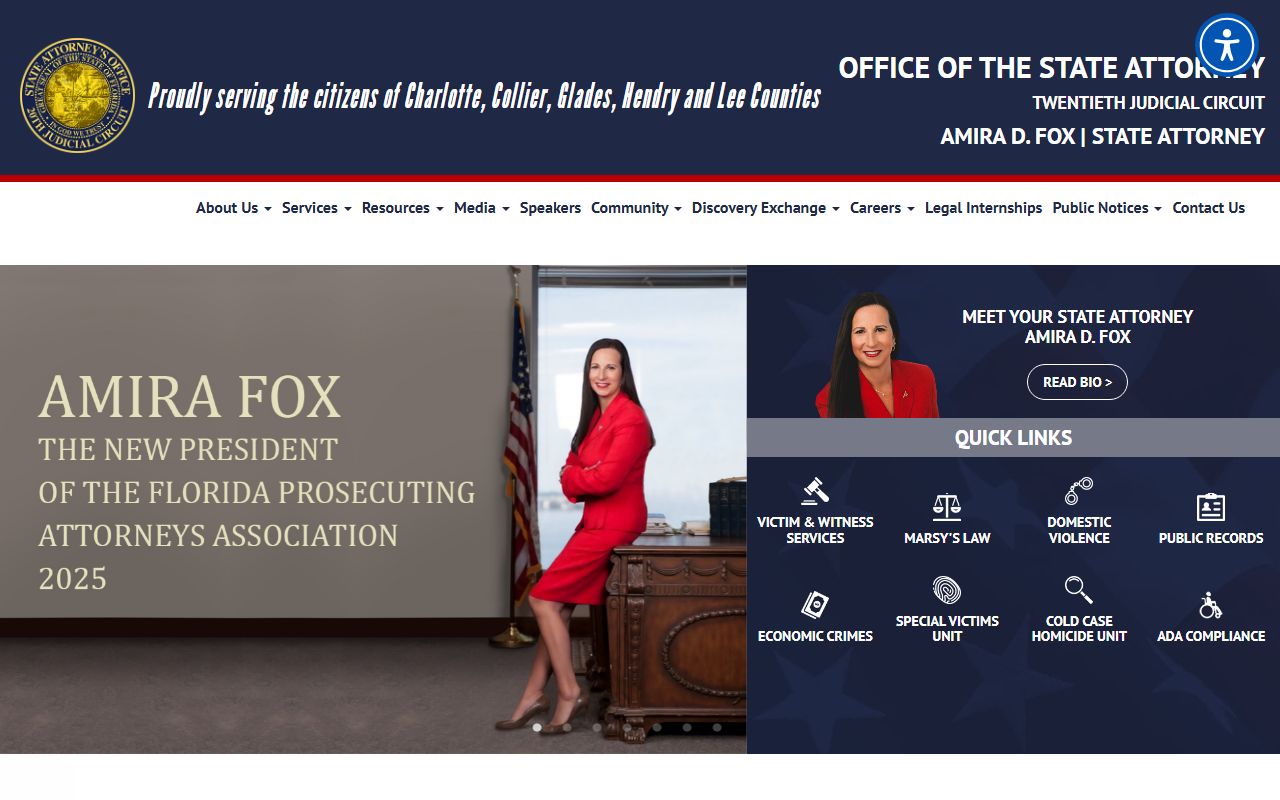
The court record starts with a charging document. After booking, the case moves to the prosecutor, who decides whether and how to charge. The State Attorney for the 20th Judicial Circuit, led by Amira D. Fox, handles Charlotte County and represents the State of Florida. The charging document that opens a case is usually a complaint, an information, or an indictment.
The prosecutor's office is one of the offices that drives what the court record shows, as seen on the 20th Judicial Circuit State Attorney site.
Each document type plays a different role in moving an arrest into a formal court case.
| Complaint | Information | Indictment | |
|---|---|---|---|
| Filed By | Officer / Prosecutor | Prosecutor | Grand Jury |
| Common For | Misdemeanors | Many felonies | Most serious felonies |
| Starts | The case | The case | The case |
Charge Status After a Charlotte County Arrest
Charges shift as a case moves. The prosecutor may amend a count, reduce it, add a charge, or decline to pursue one. That is why the booking charges on the jail roster can differ from the charges the court record finally carries. The common status terms below are what you will read on a docket.
| Status | What It Means |
|---|---|
| Pending | The charge is unresolved and the case is still active. |
| Amended / Reduced | The filed charge was changed or replaced with a lesser offense. |
| Dismissed | The court or prosecutor ended that count. |
| Nolle Prosequi | The prosecutor chose not to continue the prosecution. |
| Adjudication Withheld | A Florida disposition where conviction consequences differ from a formal adjudication of guilt. |
Bond and Release After an Arrest
Charlotte County does not publish a standalone bond schedule in the official material reviewed, but the local process points are clear. All people arrested in Charlotte County are brought to the jail and appear before a judge at First Appearance Court. Anyone who does not bond out or is not released at first appearance is housed in the jail. A hold from another agency, a U.S. Marshals matter, a probation or parole violation, or an immigration issue can keep a person in custody even when a local charge looks bondable.
| Bond Type | How It Works |
|---|---|
| Cash Bond | The full cash amount set by the court is paid directly. |
| Surety Bond | A licensed bail bond agent posts the bond for a fee. |
| PR / Own Recognizance | The court releases the person on a promise to appear, without full cash. |
| No-Bond Hold | Release is not available until a court acts or the hold clears. |
Note: a bond payment may not free a person if there is a no-bond charge, an out-of-county hold, or a federal or immigration detainer in place.
Warrants That Lead to an Arrest
An outstanding warrant is a common route into the jail. The Clerk's criminal page warns that failing to appear for a mandatory court event can lead the court to order an arrest warrant, along with a driver-license suspension. Mandatory appearance dates appear on the citation, notice to appear, or arrest paperwork, and can also be located through the Case Record Search by last name and first name.
The sheriff keeps an official warrants page, though it does not expose a full searchable warrant table in the captured material. For warrant questions, the sheriff's non-emergency line is 941-639-2101, and the Clerk's criminal division is (941) 833-3048. Records not online can be sought through a public-records request to the office that holds them. A warrant can lead to a booking once the person is taken into custody, after which the jail roster may show the local booking.
Charges vs. Convictions
Being arrested and charged is not the same as being convicted. A charge is an accusation. A conviction is a verdict or a plea. Both can be public records, but they sit at very different stages of a case.
| Charge | Conviction | |
|---|---|---|
| Stage | Accusation | Verdict or plea |
| Burden of Proof | Probable cause | Beyond a reasonable doubt |
| Public Record | Yes | Yes |
Sealed vs. Expunged Arrest Records
After a dismissal or an eligible disposition, a person may be able to clear an arrest record. In Florida, sealing and expunction run through a process with the Florida Department of Law Enforcement and the court, not through a private removal service. Eligibility depends on the charge and the outcome, and a sealed record is hidden from most public view while an expunged record is treated as if it never existed.
| Sealed | Expunged | |
|---|---|---|
| Visibility | Hidden from public view | Destroyed or treated as never existing |
| Law Enforcement | Limited access remains | Very limited access |
| Eligibility | Set by Florida law and the case outcome | Often after a dismissal or no formal conviction, per Florida rules |
Background Check Considerations
A casual court-record lookup is not the same as a regulated background check. Formal screening for jobs, housing, or credit must follow the Fair Credit Reporting Act and use a proper consumer reporting agency. A public court search can show what charges were filed, but it is not a compliant screening report.
Important: This site is not a consumer reporting agency under the FCRA, and its content may not be used for credit, employment, insurance, or tenant decisions.
Restricted Court Records After an Arrest in Charlotte County
Not every record after an arrest is open. Florida court-record rules and exemptions can close juvenile matters, sealed or expunged charges, protected-victim information, and certain investigative material. Some details are redacted before public viewing under the Public Records Act. If a record is too old, sealed, or not visible online, contact the Clerk's criminal division or inspect records in person at the Justice Center, 350 E. Marion Avenue, Punta Gorda, FL 33950.